

How much would it cost to manage used nuclear fuel in Australia?
The Claim:
The AUKUS Public Inquiry’s final report stated the cost to store and protect high-level waste (HLW) “was estimated at more than $180 billion”.
This $180B figure, repeated three times in the report and at the National Press Club, is unsourced and false misleading Australians about the economics of nuclear waste management. 
The Facts:
TL;DR: The $180 billion figure is likely an inflation-adjusted version of the cost of a proposal for South Australia to manage the world's nuclear waste from the 2016 South Australian Nuclear Fuel Cycle Royal Commission.
The proposal involved various facilities including a deep geological repository for used nuclear fuel (HLW), an intermediate-level waste (ILW) repository, a low-level waste (LLW) repository, a coastal interim storage facility, and a new port, road, railway and airport.
It would have held 13% of the world’s spent nuclear fuel (138,000 tonnes) forecast to exist by 2090 and operated for 120 years. In comparison, estimates predict AUKUS will generate 1.6–6.5 tonnes of uranium in 8–13 sealed reactor cores.
The South Australian Nuclear Waste proposal would have costed $145.3B in 2015 dollars over its 120-year life, or $181.4B in 2023 Australian dollars. It included a commercial venture to import 13% of the world’s spent nuclear fuel forecast to exist by 2090: 138,000 tonnes of spent fuel and import 390,000 m³ of foreign ILW. This venture would also include the cost of supporting infrastructure including a new airport, a new port, a new rail line, a new road and power and water supply.
As this was a proposal to manage global waste, this scale of investment would not be necessary for storing AUKUS nuclear waste, or even the waste from a future Australian civilian nuclear program.
This venture would have also included various waste repositories (figures in 2015 dollars):
- A deep geological repository for used fuel, with an intermediate-depth repository for ILW sized for 138,000 tHM (tonnes of heavy metal) of used fuel + 390,000 m³ of ILW, with a capital cost of $38B.
- A coastal interim storage facility (dry casks) that would have managed 72,000 tHM + 175,000 m³ of ILW. Its capital cost was estimated at $2.2B. This is likely how ILW and HLW would be stored in Australia, though at a far smaller capacity.
- A low-level waste repository of 81,088 m³ capacity with a capital cost of $0.8B. Australia now has a commercial repository that accepts low-level radioactive waste: the Sandy Ridge Facility in Western Australia.
The total capital cost for everything, the infrastructure and the repositories, was estimated at $41B, including a 25% growth allowance. The facility would operate over 120 years : estimated at $877.7M a year for 40 years, then $765.2M a year, operating and other costs: ~$104B.
The facility is expected to have generated $257 billion in undiscounted revenues over its lifetime, with a net present value of profits of more than $51 billion at a discount rate of 4%.
The Royal Commission reported in May 2016, over five years before AUKUS was announced on 15 September 2021. It has never claimed to be in any way representative of, or an estimate of, AUKUS costs or the cost of managing radioactive waste created specifically from a future Australian nuclear power industry.
While the exact volume of HLW produced by AUKUS is classified, estimates are 1.6–6.5 tonnes of uranium in 8–13 sealed reactor cores. This is over 21,000 times less spent nuclear fuel by weight than the figure’s 138,000 tonnes. We therefore consider the misleading use of the $180 billion figure misinformation. Beyond its unreasonable scope and costings, it was never applicable to AUKUS requirements.
Managing radioactive waste from a future civil nuclear power industry in Australia
 Render of the Onkalo Deep Geological Repository, Finland
Similarly, a future civil nuclear power industry would generate significantly less nuclear waste than the proposed facilities in South Australia would have managed.
After use in a nuclear power reactor, used nuclear fuel is stored in spent fuel cooling pools adjacent to the reactor for multiple years before it's typically placed in dry cask storage.
The most likely long-term pathway for used nuclear fuel generated in Australia would be for it to be stored in a dedicated deep geological repository. The world's first final repository for spent nuclear fuel, Onkalo, is set to commence operations in the coming months. Recently it received its operating license. Its operator Posiva has said its capital cost is ~€1B and is licensed for 6,500 tonnes of uranium. Its lifetime operating costs will be an additional ~€4B over 100 years of operation.
Used nuclear fuel can also be recycled and reused in nuclear reactors. Up to 96% of used nuclear fuel can be recycled. Currently, the used fuel from Australia's OPAL reactor is reprocessed in France.
All energy sources generate waste. The modern nuclear industry responsibly manages all of its waste with proven technical solutions.
Get the facts on nuclear waste
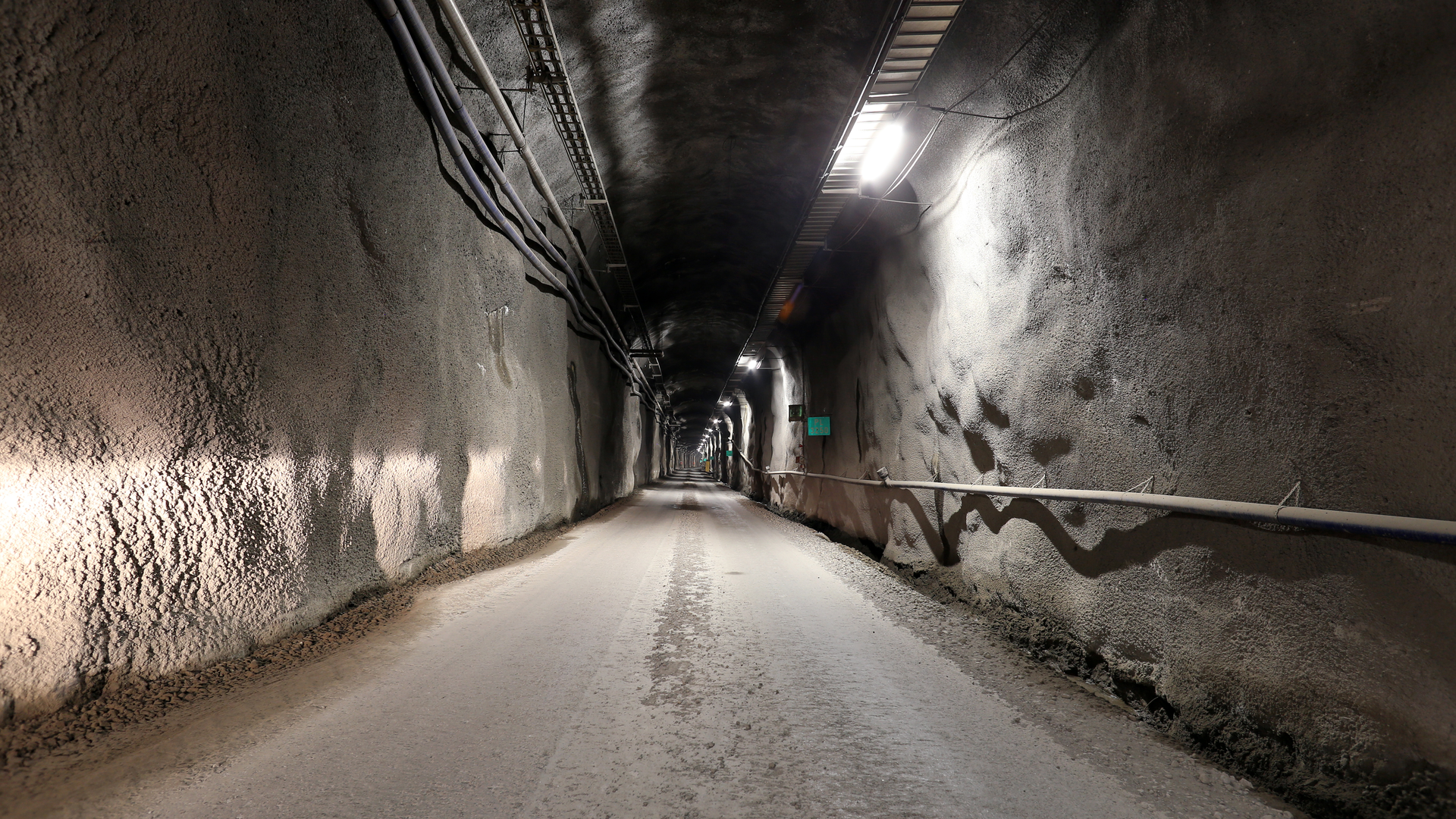
Image: "Onkalo driving tunnel" by kallerna, CC BY-SA 4.0, via Wikimedia Commons (cropped).
