
Nuclear FAQs
Why can't we run on 100% renewables?
No country has completely decarbonised with only intermittent solar and wind. When the sun isn't shining and the wind isn't blowing solar panels and wind turbines aren't generating electricity. In addition to meeting demand from our current grid, there are many challenges preventing a 100% renewable grid in Australia:
Firstly, electricity consumption is expected to double by 2050 to support electrification and electricity users such as data centres. This means that in addition to replacing current generation with renewables, we would have to double that again with more solar panels and wind turbines across the country.
Secondly, high energy users such as aluminium smelters cannot rely on the intermittence of solar and wind. With 10% of Australia's emissions traced back to the industry sector, this is a critical gap in the plan for decarbonisation.
Whilst storage and firming solutions do exist they're too expensive at the scale required (batteries & pumped hydro) and can sometimes do more harm to the climate than good (gas peaking).
There is therefore a critical role for a flexible source of clean energy like nuclear power alongside renewables in the energy mix.
Does nuclear work with renewables?
Nuclear power plants are design to provide stability to any kind of grid. Unlike solar panels and wind turbines, nuclear plants can operate 24/7, rain, hail or shine providing clean power whenever it's needed. Whilst nuclear plants typically operate at full power, it is possible to ramp power up and down by inserting and withdrawing control rods. For example in France the average 2023 nuclear power plant capacity factor (percentage of time operating at full power) was 81.5% compared to 93.1% in the United States where nuclear plants are operated as baseload generators.
Advanced reactor designs are being specifically designed to work alongside renewables. For example, Terrapower's Natrium Reactor has a molten salt energy storage tank which acts as a thermal battery. When power is needed because the sun isn't shining or wind isn't blowing the hot molten salt will pass near water filled tubes to make steam to turn a turbine generating on-demand clean electricity.
 Natrium Single Unit Site Diagram (Terrapower)
Does nuclear stack up economically?
A balanced energy mix of nuclear complemented by renewables is the cheapest path to decarbonisation.
Power bills have been rising dramatically in Australia as a result of the renewables-only energy transition. Whilst solar panels and wind turbines may be cheap to install, the cost of batteries and other storage technologies (such as pumped hydro) required to keep the lights on when the wind isn't blowing and sun isn't shining is a huge expense. Moreover, there are exorbitant costs associated with the poles and wires (transmission lines) needed to connect the many new solar and wind farms being built. These costs are not fully factored into comparisons between a grid with nuclear and a grid with intermittent renewables only.
A study by the United States Department of Energy found nuclear power in the mix alongside renewables reduced system costs by 37% and a recent report by Frontier Economics found adding nuclear to Australia's mix could reduce costs by 25%. Nuclear power in the mix would provide the flexible stability the grid requires reducing the need for expensive storage and transmission projects.
How soon could Australia have nuclear?
The official IAEA prediction for the time it will take Australia to develop a nuclear power programme from announcement to operation of the first reactor is 10-15 years. This timeline is echoed by many nuclear experts.
How soon Australia could have a nuclear power plant operational:
- Globally renowned nuclear lawyer Helen Cook: 10 years
- Adjunct Nuclear Law Professor at the University of Adelaide Kirsty Braybon: 11 years
- Director of Centre for Advanced Nuclear Energy Systems at MIT Jacopo Buongiorno: Under 12 years
These timelines are impacted by many factors, particularly political will.
Is nuclear power safe?
Nuclear power is statistically one of the safest energy sources even when past accidents are taken into account. In fact, you receive less radiation living near a nuclear plant for an entire year than eating a banana according to the University of California.
Modern nuclear plant designs from companies such as Westinghouse, GE Hitachi and Rolls Royce have advanced safety systems that can work without human intervention. Due to lessons learnt from older reactor technologies, there has not been a single meltdown at any nuclear plant built in the last 40 years.
Learn more about nuclear safety
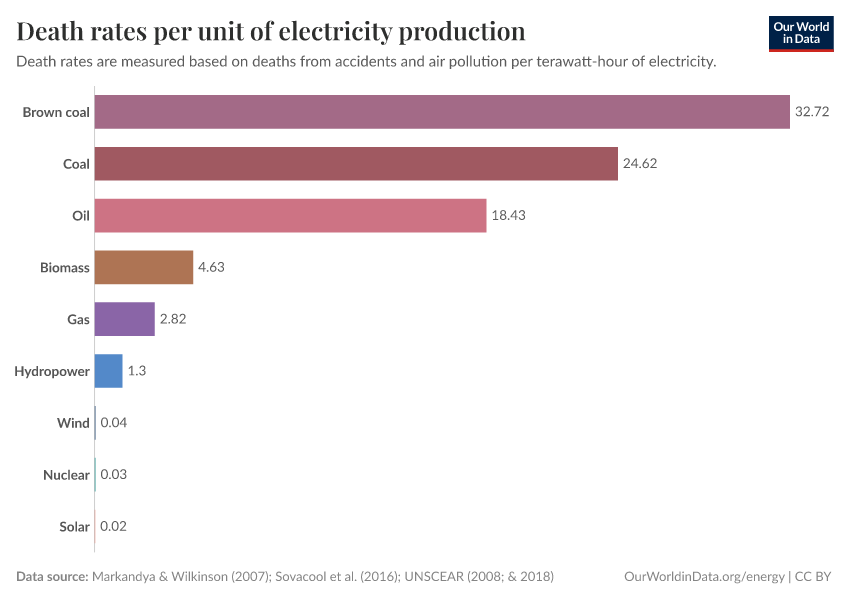
Source: Our World in Data
What about the waste?
Australia already safely manages low and intermediate level radioactive waste. In terms of used nuclear fuel, we are already recycling the waste produced from our research reactor in Sydney. Other proven options for the safe management of high level radioactive waste include storage in dry casks or long term disposal in deep geological repositories. Fortunately, due to nuclear power's energy density it produces significantly less waste than other energy sources like fossil fuels, solar or wind.
Learn more about radioactive waste management

Nuclear for Australia founder Will Shackel hugging a nuclear waste canister at Sizewell B
Doesn't nuclear need water?
Just like coal plants, nuclear power plants require cooling water. The majority of water is withdrawn and then released back into the original water source which could be an ocean, river or lake. Since the water required for cooling is circulated through a seperate loop to the reactor it does not become radioactive. If water is scarce, nuclear power plants can use treated waste water or dry cooling.
Learn more about nuclear and the environment
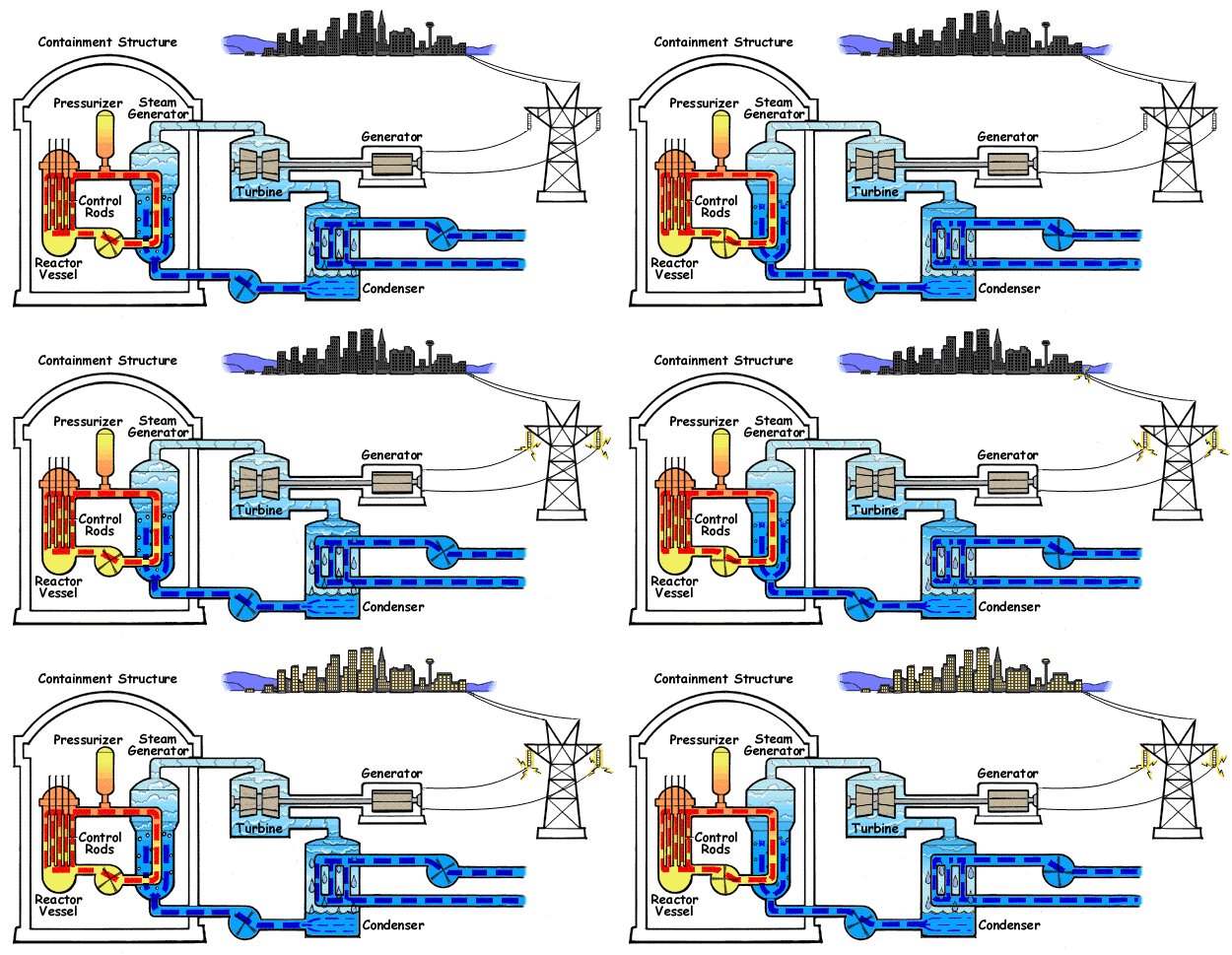
Pressurised Water Reactor Animated Diagram
What do the experts say about nuclear?
There are many experts pushing for nuclear power in Australia's energy mix. Nuclear for Australia has a team of nuclear experts with decades of experience. Members of our expert working group include:
- Dr Adi Paterson Former CEO of Australia's Nuclear Science & Technology Organisation
- Dr Robert Barr AM Director of Electric Power Consulting
- Tony Irwin ANU Honorary Associate Professor
- Jasmin Diab Australian Managing Director of Global Nuclear Security Partners
- Lenka Kollar Co-founder of Helixos
- Kirsty Braybon Adjunct Lecturer in Nuclear Law at the University of Adelaide
- Mark Schneider Former Reactor Operator in the US Navy and at Surry Power Station
- Peter Anusas Managing Director of BMD Group UK
- Simon Earp Former Reactor Operator in the UK and at Three Mile Island in the US
Was this helpful?