
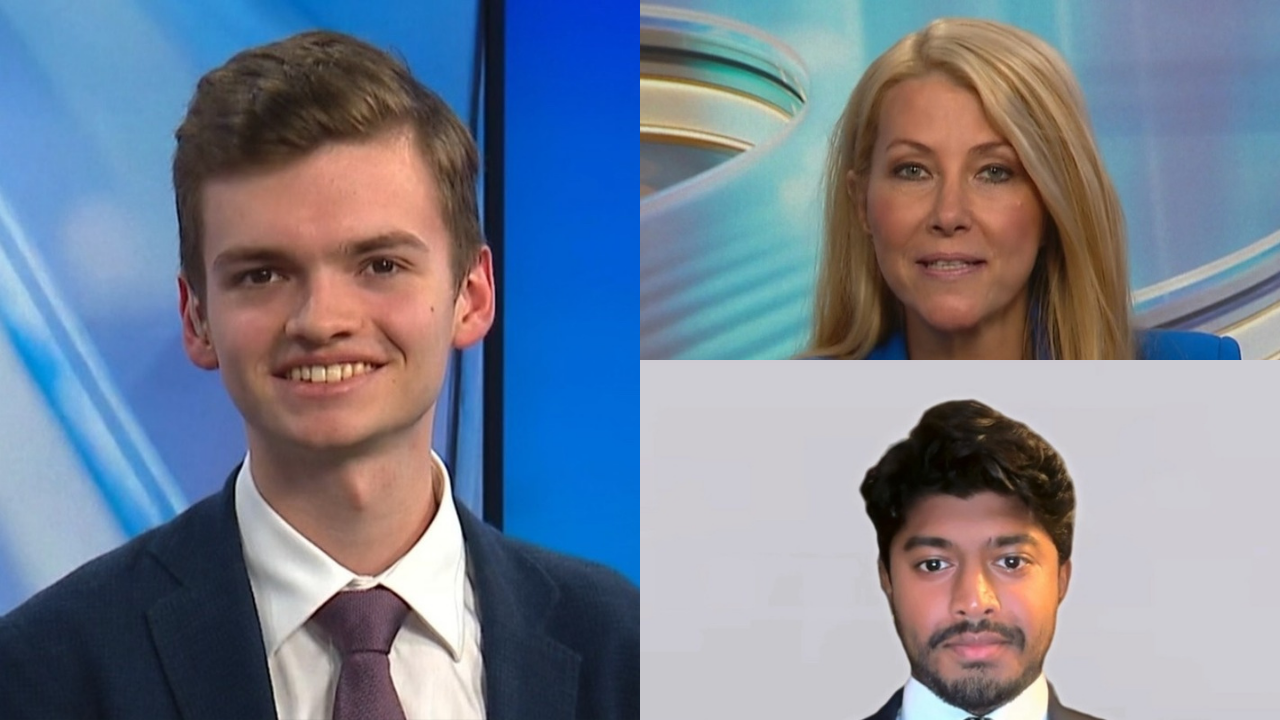
Nuclear for Australia founder Will Shackel joined Jaynie Seal on News24's Weekend Newsday, alongside fusion researcher Abdus Saboor, to discuss how AI's soaring energy demand is driving global interest in nuclear fission and fusion, and why politics is holding Australia back.
Interview Transcript:
Jaynie Seal (Host): Well, the demand for energy use is dramatically increasing with the use of AI, and the International Energy Agency has reported that energy demands from AI data centres could quadruple by 2030. And according to the United Nations, a single question put to an AI assistant, like ChatGPT, uses approximately 10 times more electricity than a standard Google search. Well, this has certainly sparked worldwide interest in energy demands and types of energy, including nuclear fission and fusion. And joining us live is the founder of Nuclear for Australia, Will Shackel, and Abdus Saboor, who is the co-founder of Indimaj Group and a researcher in nuclear fusion materials at Imperial College in London. Thank you both so much for joining us. Will, let's start with you, because you've been to quite a few events this week. What were some of the standouts?
Will Shackel (Founder of Nuclear for Australia): Look, I think across the board, it's just the fact that politics is getting in the way of anything nuclear in Australia. I was at a fusion conference: we're one of the only advanced economies without a fusion strategy. I was at a uranium conference, and the South Australian Labor Treasurer was wondering why none of the other states were acting to lift their uranium mining prohibitions. And then at nuclear conferences, where we were, of course, discussing, as we always do, why Australia is the only member of the G20 with a national prohibition on nuclear power, when all of these other countries around the world use it to provide clean, reliable, secure energy. So big takeaway is just politics is getting in the way of everything nuclear in Australia.
Jaynie Seal (Host): All right. And so there's nuclear fission that you're talking about, and, Abdus, there's nuclear fusion, and you work a lot in fusion, and you've got the co-founding organisation. You've been to Canada, you've been doing so much work, you've been to Australia as well. Talk us through what fusion is, and we're hearing it's the next big boom in AI.
Abdus Saboor (Co-founder of Indimaj Group): So thank you very much, Jaynie, first of all, for having me on. The fundamental difference between fission and fusion is, both of them are nuclear processes. Fission is where you've got the large atom that you basically split into two, and fusion is you've got smaller atoms that you then fuse into making a larger atom. Now, what I would say is the next boom in deep tech is fusion, and there's a reason behind why I say that. Just today I was reading a quote by Thomas Forner from Focused Energy, when he was talking about how AI hasn't just given us a breakthrough, it's given us a deadline for fusion, because we need to be able to power these data centres. Now, in 2022, you had a massive fusion boom at the National Ignition Facility in the US, where fusion, you know, we had a greater energy output than energy input. And what that led to is a massive boom in the private fusion industry, with a near exponential rise in investments into fusion. So I would say the next fusion boom, where the entire world would now be looking at the next AI essentially, would be next year. So when, you know, companies like Helion and Commonwealth Fusion Systems, two of the largest fusion companies in the world, will be turning on their demonstration plants live, that's when, you know, countries will be trying to think about what their fusion strategy should be. So if people ask when the right time is, I would say the right time is now to look at building a fusion strategy. And as Will said, you know, Australia is one of the most advanced countries in the world that doesn't have a fusion strategy, so that's something that Australia should be definitely looking into.
Jaynie Seal (Host): And would you agree with that, Will, because you went to one of the events which was focused purely on fusion?
Will Shackel (Founder of Nuclear for Australia): And Australia actually has many start-ups already involved in the fusion space, because fusion technically isn't impacted by Australia's nuclear prohibitions. There needs to be a clear signal from government, because there are all of these start-ups doing incredible work. In fact, Australia was a world leader, having one of the first tokamaks after Russia. So Australia actually has, you know, a real great head start in the fusion space, but with all of these technological developments, I think it's really important that the government make clear that they would have an open mind to fusion in Australia.
Jaynie Seal (Host): And we just had a debate with John Ruddick, who's a Libertarian, and Greens MLC Sue Higginson last hour. It was a very fiery debate, I might add. And, you know, you've got the Greens, for example, who are very pro looking after the climate. So if we look at what happened with COP28 in 2023, and you talk us through, Will, how many countries... there's 39 countries that have signed the triple nuclear pledge, I should say, you can say it a lot better than I can. What are you seeing there? Because we're not part of that, but that is, you know, to lower emissions.
Will Shackel (Founder of Nuclear for Australia): Well, and we've just seen Pre-COP, where Australia was hosting, and then Australia's got the President of Negotiations in our climate minister, Chris Bowen. We're really, you know, an outlier on the global stage when it comes to using nuclear energy as a climate solution. Like you said, 39 countries, representing now over 70% of global GDP, and there's more countries being added all the time, have committed to triple nuclear capacity globally by 2050. And some countries, including the US, are going further than that: quadrupling. The International Atomic Energy Agency currently has projections which show that nuclear demand is set to increase from all of these countries around the world, and there's around 60 who are either in the process of adding nuclear power to their mix or are actively considering it, including many in our region. So we've got huge challenges when it comes to energy supply in Australia, but if we're going to meet that with decarbonised, clean energy sources, nuclear power must be in the mix.
Jaynie Seal (Host): And what I hear mostly, Abdus, it's not about eliminating renewables. Most people that we speak to, scientists, nuclear engineers, are very pro-renewables. They're saying that we need, you know, the nuclear energy in the mix for the baseload energy and power. You've been to Canada, as we mentioned. Talk us through what you're seeing where you are in the UK, and perhaps, you know, some of the other countries' perspective on COP and climate change.
Abdus Saboor (Co-founder of Indimaj Group): That's a very interesting question. So I would say in the UK you've got a massive growing appetite for fusion and fission, right? So you've got the All-Party Parliamentary Groups, which are multi-party groups focusing on different topics, two of them being fusion and fission. And these groups are growing in size. You know, a lot of MPs are showing interest in fission and fusion. You know, the Department for Energy Security and Net Zero is heavily focusing on trying to understand how the UK could be a part of the global fusion landscape. COP is a very interesting question, because this year it's being hosted in Turkey. Turkey doesn't really have a fusion strategy, but they're already involved in Akkuyu, which is their first sort of fission plant that's being built. And Turkey, one of the Middle Eastern countries, and the wider Middle East, they realise that they need to have nuclear as a baseload source of power. So I was in Saudi Arabia recently for LEAP, and, you know, AI was a big topic, but the other question was, how do we now power AI? And, you know, nuclear, SMRs, fusion, fission, these are all parts of the conversations in Saudi Arabia. I was also in Canada, as you mentioned, and in Canada, you know, the Canadians have been working on their CANDU reactor, which is a homegrown nuclear reactor, for a very long time. And there's obviously a massive appetite for fission there, and a growing appetite for fusion, because you've got General Fusion based in Canada, the first fusion company that has gone public. So there's a massive growing appetite in emerging markets, which is where I work, such as the Middle East, but there's also an existing and growing appetite for things like fusion in the UK.
Jaynie Seal (Host): We've got to wrap it up, but just quickly, Will, I saw you nodding there at what Abdus was saying. Yeah, so COP is going to be in Turkey. And what are your thoughts on what Abdus just said?
Will Shackel (Founder of Nuclear for Australia): Well, they're about to open a nuclear plant in Turkey. So here we've got another country where Chris Bowen will be at. I wonder if he's going to actually take a tour of the nuclear power plant they have there, because there are so many countries, even countries you couldn't possibly believe would have nuclear power, who are doing this. It really just shows how much of an outlier Australia is at the moment.
Jaynie Seal (Host): Will, thank you so much. We'll have to do this again very soon.
[End]
This transcript was generated with the assistance of AI and may contain errors.